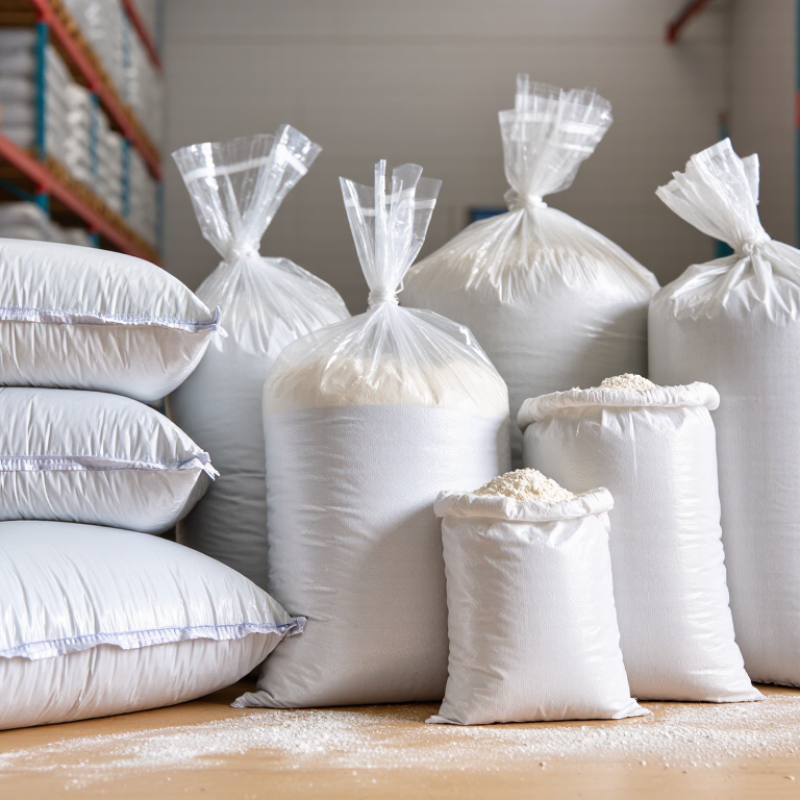
| Bag Capacity | Choose a nominal capacity of 5 kg, 10 kg, 25 kg, or 50 kg according to the distribution channel. | The correct size reduces unused space, limits product movement, and improves pallet stability. | Fill a sample bag to its target weight and confirm that the seams, shape, and closure remain stable. |
| Fabric Construction | Use woven polypropylene tape fabric with consistent weaving and suitable tensile strength for the intended load. | Woven PP provides a strong, lightweight structure that can withstand handling and stacking better than many ordinary paper sacks. | Inspect the weave for broken tapes, loose threads, holes, uneven density, and weak corners. |
| Lamination | Select laminated PP woven fabric when improved moisture and fine-powder resistance is required. | A continuous laminated layer helps reduce moisture penetration and limits flour dust escaping through the fabric. | Check lamination uniformity, adhesion, pinholes, wrinkles, and surface separation after flexing. |
| Inner Liner | Use a food-contact-suitable PE liner for fine flour, extended storage, or higher moisture protection. | The liner creates an additional barrier against contamination, leakage, and moisture transfer. | Confirm that the liner fits the bag correctly, has no holes, and is securely closed during filling. |
| Seam Type | Use reinforced sewn seams or heat-sealed construction designed for the bag material and filling process. | Seams are high-stress areas and must resist bursting when bags are lifted, dropped, or stacked. | Perform seam inspection and drop testing with filled bags from the normal handling height. |
| Closure Method | Choose sewn, heat-sealed, pinch-bottom, or valve closure based on filling equipment and required dust control. | A suitable closure helps prevent flour leakage, protects product quality, and supports efficient automated filling. | Test closure integrity after filling, compression, pallet stacking, and repeated handling. |
| Fabric Weight | Common commercial constructions are approximately 55–110 g/m², depending on bag size and strength requirements. | Higher fabric weight can improve durability, but the best choice balances strength, cost, and handling weight. | Verify fabric weight and compare it with tensile, seam, and drop-test results rather than judging thickness alone. |
| Food-Contact Safety | Specify virgin or approved food-contact materials for all surfaces that directly touch the flour. | Food-contact compliance helps prevent unacceptable migration, odor transfer, and contamination. | Request material declarations, compliance documentation, and test reports applicable to the destination market. |
| Moisture Protection | Use laminated fabric, an inner liner, or both for humid climates and longer storage periods. | Flour can absorb moisture, leading to caking, reduced flowability, and quality deterioration. | Conduct moisture-barrier evaluation and store filled samples under the expected temperature and humidity conditions. |
| Dust Control | Select coated fabric, a liner, or a valve-style closure for fine flour and high-speed filling operations. | Reduced dust leakage improves workplace cleanliness, product retention, and packaging-line performance. | Observe dust release during filling, closing, conveying, stacking, and bag inversion. |
| Pallet and Storage Performance | Use a stable rectangular format with consistent dimensions and a surface suitable for stacking. | Uniform bags improve pallet utilization, reduce leaning, and help protect packages during transport. | Build a representative pallet and check deformation, slippage, compression, and corner damage. |
| Printing and Traceability | Use durable, food-packaging-appropriate printing with space for product name, net weight, lot code, and storage instructions. | Clear information supports identification, stock rotation, regulatory labeling, and quality tracking. | Check print adhesion, legibility, color consistency, and resistance to rubbing and moisture. |
| Sustainability and Reuse | Prefer mono-material PP construction where practical and confirm whether local recycling systems accept the packaging. | A simpler material structure can support recycling, while durable construction may enable reuse in suitable applications. | Review material composition, recycling guidance, and end-of-life requirements for the target market. |